ODC / OWC · Diwali 2026

From this Diwali 2026

ODC & OWC cargo inspection in India

ODC / OWC will never be the same. Cargo risk, engineered into evidence.

Need one ODC inspection or a repeat programme? Place a bid by volume, weight and value.

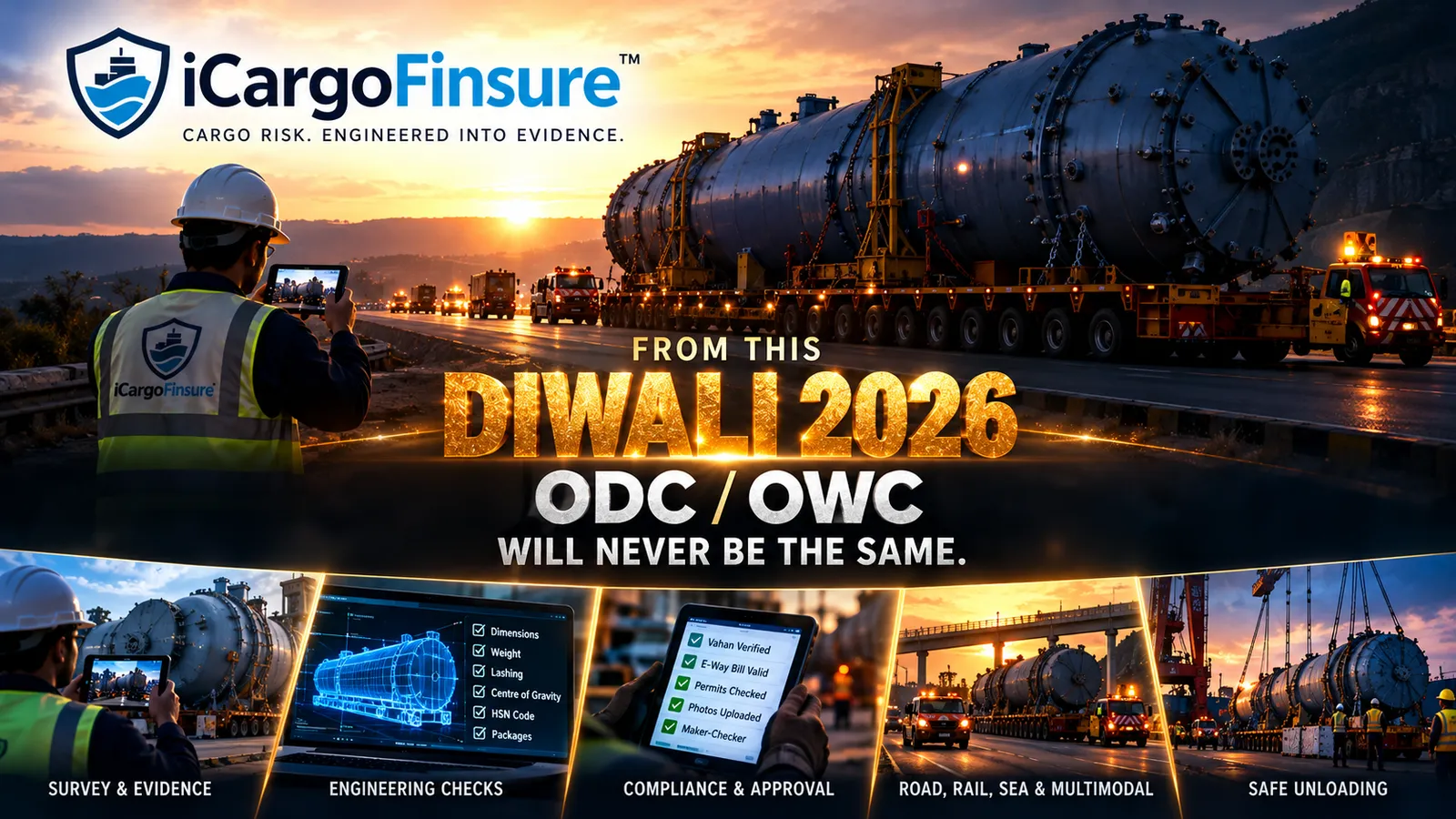
An over-dimensional vessel on a modular trailer, escorted by a convoy along a highway at sunset.
  • EvidencePhotographs, documents, cargo
  • EngineeringForces, friction, securing
  • AccountabilityMaker, checker, decision

Why now

India’s energy build-out rides on over-dimensional trailers.

Grid corridors, battery storage and wind parks are putting record volumes of ODC and OWC cargo on national highways. Each load needs evidence an insurer can rely on.

70+

Transformers

765 kV-class transformers and shunt reactors ordered for renewable corridors, with deliveries running 2026 to 2027 across several states.

Source: GE Vernova
8.2 GWh

Battery storage

Added in India in the first half of 2026, with a further ₹5,400 crore of viability-gap funding approved in May 2026 for 30 GWh more.

Sources: ESS News, Wingzman
91.2 m

Wind blades

India’s longest onshore blade is being readied at Mundra. Blades of 78.6 m and 80.5 m are already in production, over four times the 18.75 m length limit.

Source: News24

The rules also matter. MoRTH’s October 2025 circular sets online permission for single indivisible ODC/OWC loads on modular hydraulic trailers, capping each axle row at 18 t (circular RW/NH-35072/01/2010-S&R(B)PT-2, 27.10.2025).

Why iCargoFinsure

Why us: evidence first, people in charge, proof you can read.

Heavy cargo needs more than a checklist. It needs one record that every party can trust, built the same way on every move.

Built on real movements

Our benchmarks come from a transformer maker’s book of 207 trips and 242 ODC and OWC inspections, fully anonymised. See the numbers.

People decide, software prepares

AI-assisted readings are confirmed by a human maker and signed by a checker. Nothing is approved by the software alone.

Evidence an insurer can read

Photographs, securing checks and maker-checker records in one standard record, from the first photograph to safe unloading. See how it works.

Practise before the truck moves

The Field Academy walks you through the maker, checker and unloading steps with demo data. Enter the Academy.

How it works

One job record, from the first photograph to safe unloading.

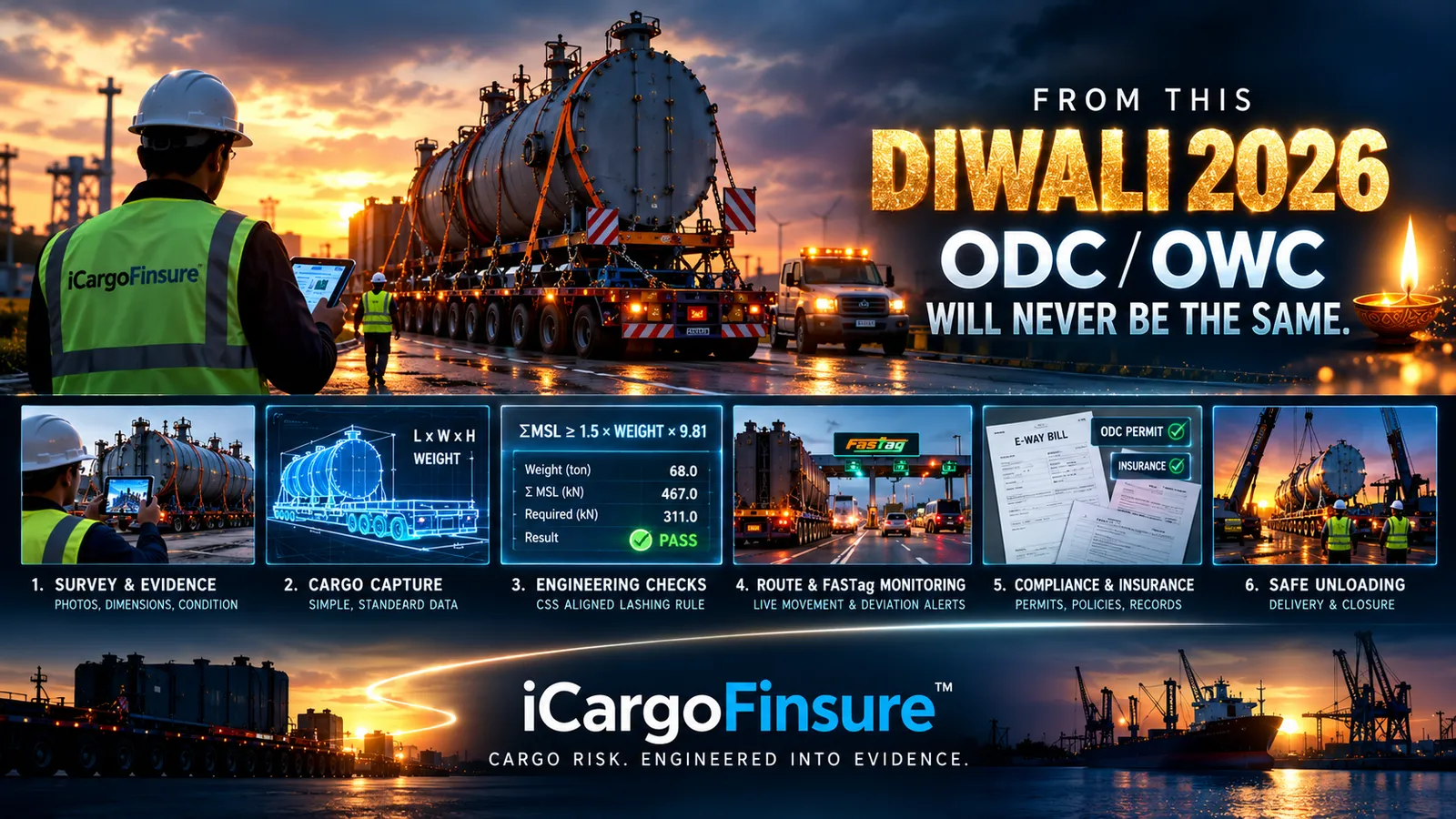
  1. Survey and evidence

    Photographs, dimensions and condition captured at the cargo.

  2. Cargo capture

    One standard record of what is moving, in metres and kilograms.

  3. Engineering checks

    Securing capacity checked against the load, with the reasons shown.

  4. Route and FASTag monitoring

    Movement and deviation tracked against the approved route.

  5. Compliance and insurance

    Permits, policies and records kept with the job.

  6. Safe unloading

    Delivery readiness and closure evidence, then the record is signed.

Every AI-assisted reading is confirmed by a human maker and signed by a checker. Nothing is approved by the software alone.

Real reports

Same physics. Three verdicts.

Every move is a contest. The cargo pulls one way; the vehicle and the lashings must hold the other. Download three real inspection reports, with names, tax numbers, vehicles, drivers and addresses removed, and see where each one landed.

Action: what the move asks of the load Reaction: what holds it Where the bars meet shows who is winning.

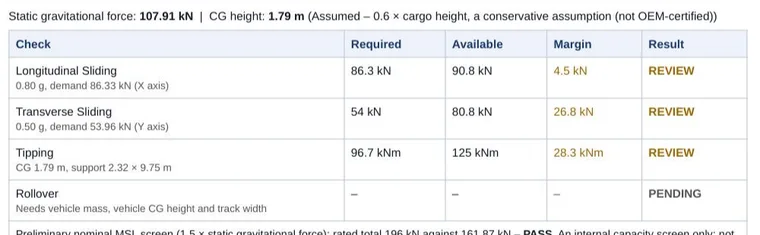
Cleared, with notes

Chiller, 11 t: the lashings hold

Excerpt of a real securing check from an inspection report: the forward and sideways sliding checks and the tipping check all pass with a margin, shown as REVIEW because the figures rest on assumed inputs.

Loading

Cargo 11,000 kgVehicle payload 26,820 kg

Inside the payload by 15,820 kg

Lashing

Forward pull 86.3 kNLashing hold 90.8 kN

Holds, 4.5 kN to spare

Provisionally adequate. The report lists what is still assumed (centre of gravity, friction, lashing angles) so the checker can close it.

Download this report PDF, 0.7 MB, 6 pages

Fix before moving

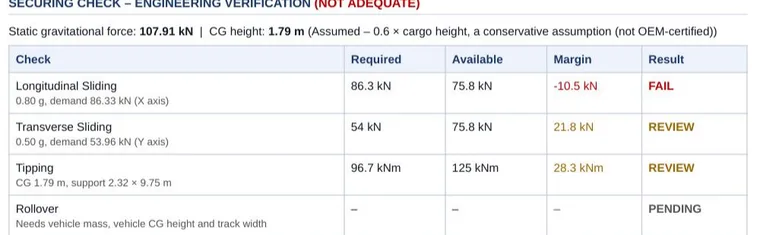
Chiller, 11 t: the total passes, one direction fails

Excerpt of a real securing check: forward sliding fails by 10.5 kN although the total lashing capacity passes the 1.5 times rule.

Loading

Cargo 11,000 kgVehicle payload 26,290 kg

Inside the payload by 15,290 kg

Lashing

Forward pull 86.3 kNLashing hold 75.8 kN

Short by 10.5 kN

The total lashing capacity passes the 1.5× rule (196 kN against 161.9 kN), but the lashings that oppose the forward pull are not enough. The move is conditional on more hard securing at the front and rear.

Download this report PDF, 0.8 MB, 6 pages

Do not dispatch

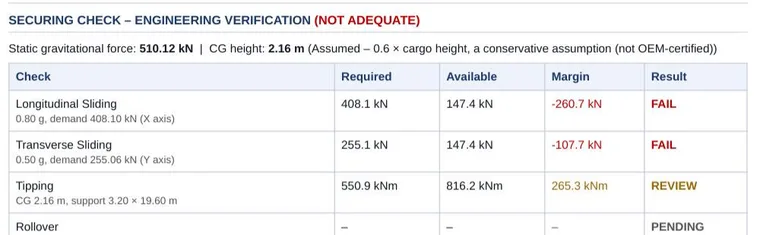
Heavy plant, 52 t: stopped at the gate

Excerpt of a real securing check: forward and sideways sliding both fail, and the report is marked not adequate.

Loading

Cargo 52,000 kgVehicle payload 40,750 kg

Over the payload by 11,250 kg (27.61%)

Lashing

Forward pull 408.1 kNLashing hold 147.4 kN

Short by 260.7 kN

Movement clearance on hold: the cargo exceeds the vehicle's registered payload, and the lashings are far short. Caught before the truck moved.

Download this report PDF, 1.0 MB, 8 pages

Real inspections, redacted. The securing check is an internal screen on stated inputs, not a certified calculation. Figures are the report's own.

See what this means for your next heavy move.

Book a live demo

The film

Forty-five seconds on why heavy cargo needs a record.

Starts only when you press play. Sound is on when you unmute.
Read the transcript
  1. 2.6 m breadth. Beyond this, it’s ODC.
  2. Every ODC move begins with one question.
  3. Inspect. Verify. Review.
  4. F = m · g. The physics.
  5. Photographs become proof. Physics becomes a verdict. Every lift, on the record.
  6. Heavy cargo has waited long enough.
  7. From this Diwali 2026, ODC / OWC will never be the same.
  8. iCargoFinsure. Cargo risk, engineered into evidence.
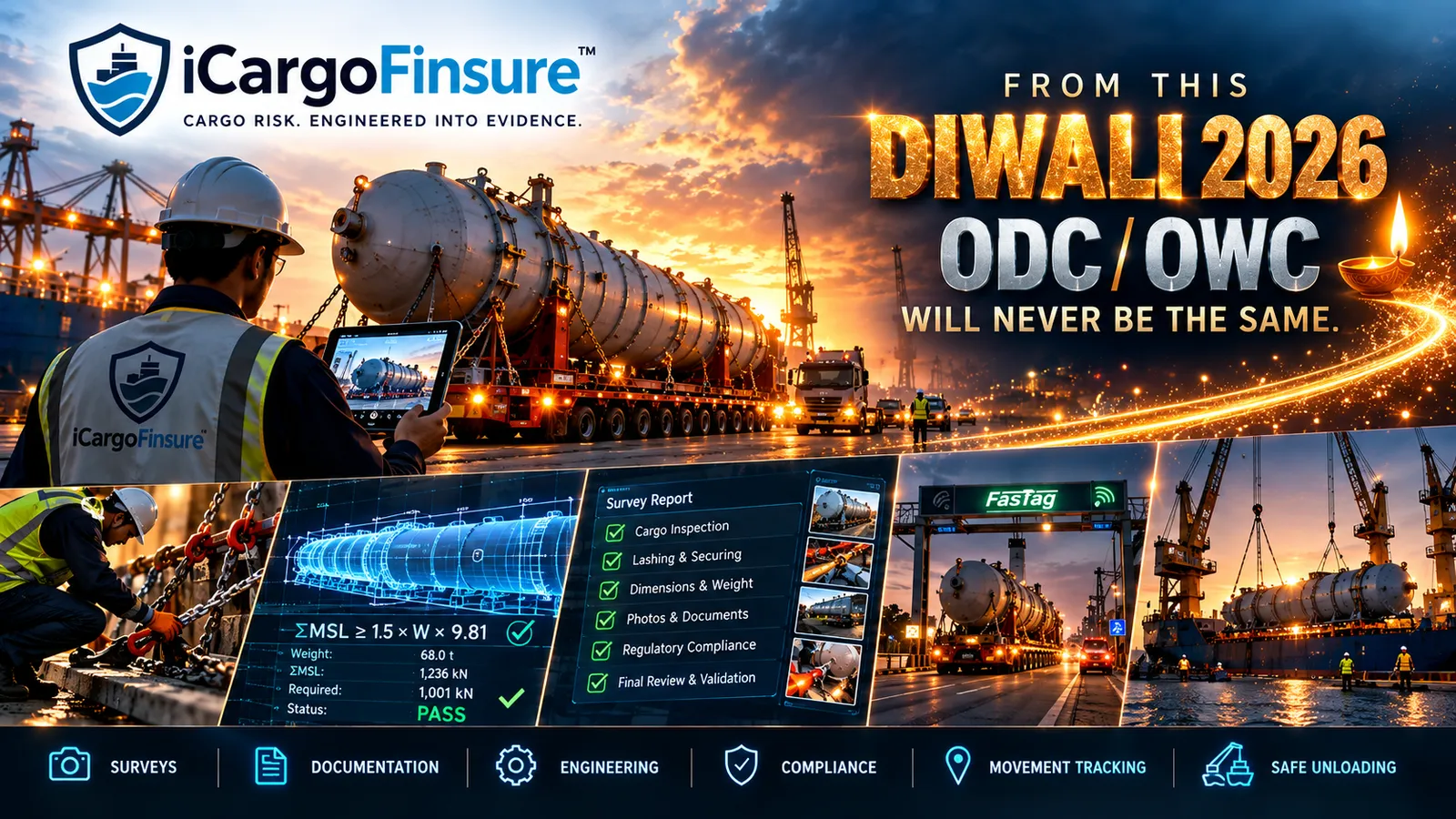
An inspector photographs an over-dimensional vessel on a modular trailer at a port at sunset; panels show the force calculation passing and a survey report checklist.
Evidence at the cargo
An inspector with a tablet beside a long vessel on a trailer convoy at dusk, with panels for survey, engineering checks, compliance and safe unloading.
Engineering, compliance, safe unloading
An inspector with a tablet beside a vessel on a multi-axle trailer; six steps from survey and evidence to safe unloading.
Six steps, from survey to closure
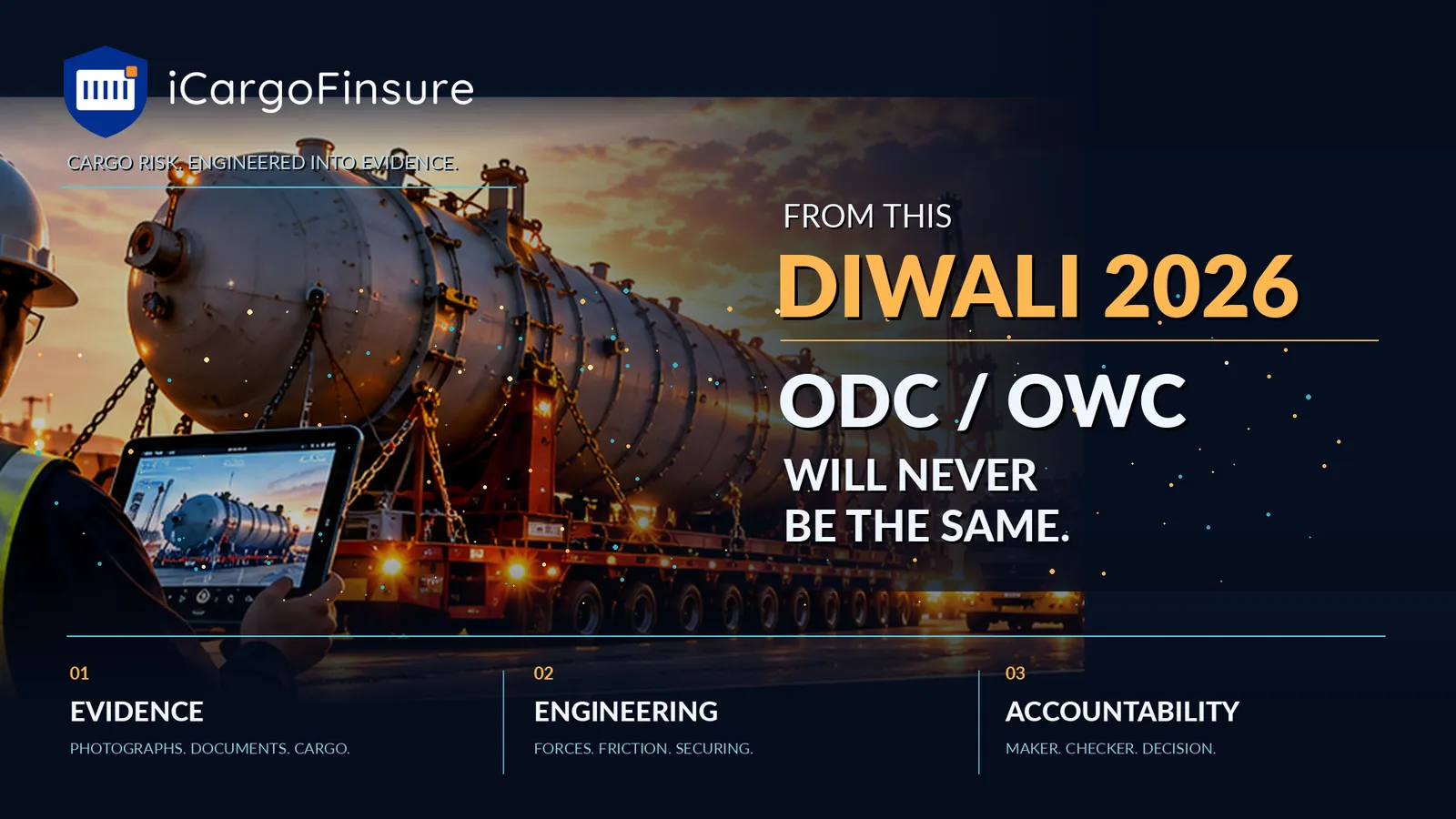
Diwali 2026 ODC / OWC will never be the same, with evidence, engineering and accountability.
Evidence. Engineering. Accountability.

Diwali 2026 · frame 1 of 4

Evidence at the cargo

Illustrative campaign artwork, not photographs of real cargo or customers. The force figures in the artwork are examples.

See what this means for your next heavy move.

Book a live demo

What our clients say

Early results from two pilot clients.

Inspect first, and the losses and the inspection spend both move. Figures are reported by iCargoFinsure from client pilots; clients are not named.

Power transformers

Transformer client 1

Reduction in loss ratios
2×
Reduction in inspection expenses
0.5×

Industrial chillers

Chiller client 2

Reduction in losses
1.3×
Reduction in inspection costs
0.5×

Anonymised, client-reported pilot figures for two clients, April to December 2025: loss ratios on annual turnover and survey fees. The basis is in the research papers on SSRN and Zenodo. Clients are not named. Results vary by cargo, route and operator and are not a guarantee.

The numbers

Built on real movements: 207 trips and 242 inspections.

A transformer maker’s book and the 2025 inspection file, fully anonymised. Hover any bar for its value.

₹226.66 CrExposure analysed
60.87%Held by the top 10 routes
242Inspections in 2025
11Days: the worst delay, against a 2-day P90

Exposure by carrier

Delay distribution

Route concentration

Open the full analytics Read the research

The vision

A tree grows from what is true.

Every trade starts as a root: a real cargo, photographed, measured and recorded. From that root rises one trunk, a single record every party can trust. Branches reach out to surveyors, transporters, insurers and financiers, and leaves carry the documents, the movements and the money. Grown far enough, the tree becomes embedded, insurance-integrated logistics for the whole trade. ODC and OWC cargo is where we plant it first.

  1. Rootsthe cargo and its evidence, captured at the source
  2. Trunkone record for the whole move
  3. Branchesevery party to the trade, connected to that record
  4. Leavesdocuments, movements and money, each tied back to a root
  5. CanopyEmbedded Insurance-Integrated Logistics

Plant it with us: book a live demoEarly partners help decide what grows next.

Pilot scope: two categories, MoRTH and non-MoRTH, which you switch between in the app. The pilot data holds only the unit of measure, quantity and HSN code of what was floated: no names and no values.

Our book, Cargo OK Please: The Ultimate Guide to Over-Dimensional Cargo, Loss Prevention & Marine Insurance in India’s Supply Chains, by AM Gawarikar and Varun Ashok Gawarikar: see it on Amazon India, or read about the book and buy the Kindle or paperback edition.

Granted patent: Cargo Assets Systems Insurance Interface (CASII). Filed 30 April 2025, granted 2 March 2026. Source: Patent Office, Government of India.

Bid system

Bid for your ODC inspections, or book a live demo.

A bid is your intent to move ODC cargo. Tell us the movement: one inspection or a repeat programme, and its volume, weight and value. Insurers, brokers, surveyors and shippers bid the way tenders are drawn, and we come back with a response for your cargo.

  • Bid on the market page: MoRTH or non-MoRTH, one inspection or repeated.
  • See three real, redacted reports before you book.
  • Diwali 2026 enterprise founding partners: qualify and contract by 8 November 2026 for up to 30 included inspections before 2027; billing from 1 January 2027. Details and terms. *T&C apply.
  • An early workflow feedback channel with the product team.
  • Enterprise, insurer and surveyor-network onboarding.

Book your call or demo

Takes about a minute. Step 1 sends your request; step 2 is optional.

Step 1 of 2

Your details

Inside the app

Real screens, real rules. Fragments only.

Cropped from the current iCargoFinsure customer workspace and filled with demo data. The full workflow stays behind the demo.

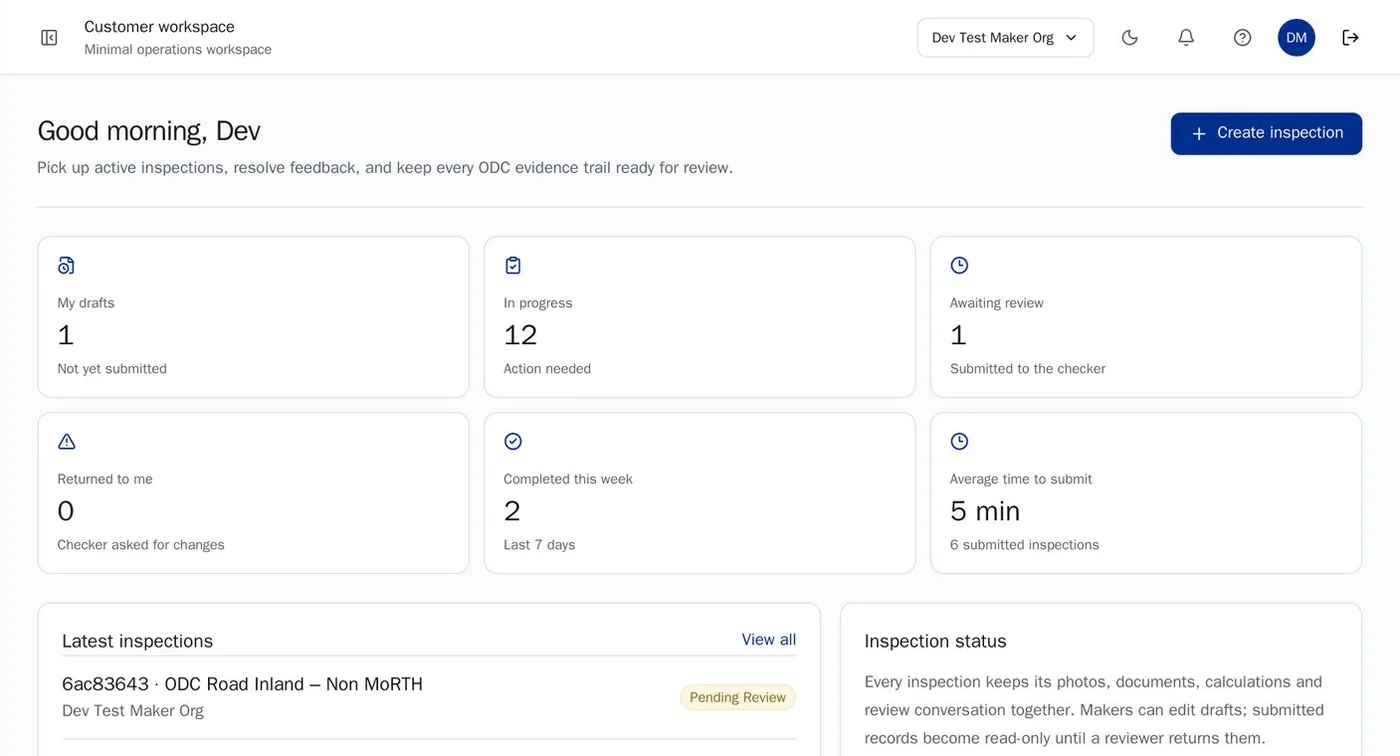
Maker home

Counters for drafts, work in progress, awaiting review and returned inspections, with the latest records below.

Tap the screen to enlarge. No client information is shown.

Engineering check

Is the securing capacity enough for the load?

Change the weight or the available capacity and watch the verdict. The worked example is a 68 t vessel.

Sum of the maximum securing loads of the lashings fitted.

ΣMSL ≥ 1.5 × W × 9.81 (kN)

Email me this result We email your inputs and this result, with the standing disclaimer. The calculator works without it.

Consent wording

Illustrative. Not a certified securing-adequacy calculation.

See what this means for your next heavy move.

Book a live demo

ODC / OWC checker

Is your cargo ODC, OWC, or both?

Units are normalised to metres and kilograms before comparing, as the app does on every maker save. Your entries are kept on this device.

Want to see where a real move lands? See three real inspection reports.

Used only for the indicative HT class.

Email me this result We email your inputs and this result, with the standing disclaimer. The checker works without it.

Consent wording

For whom

One inspection language for every party to the move.

Corporates and assureds

Standardise ODC inspections across plants and logistics teams, and keep warranty evidence that holds up at claim time.

Surveyors

Guided capture, AI pre-filled forms and one-tap reports. Join as a surveyor.

Insurers and brokers

Consistent, checker-signed evidence for marine-transit underwriting and faster, evidence-backed settlements. Read the insurer brief.

Transporters and EPCs

Route, driver, trailer, securing and unloading linked into one job record your client and insurer both accept.

See what this means for your next heavy move.

Book a live demo

Field Academy

Take the inspector’s seat before a truck moves.

Pack the evidence. Measure the load. Question the lashing. Hand the file to your checker, then follow the cargo to final rest. Your progress is saved.

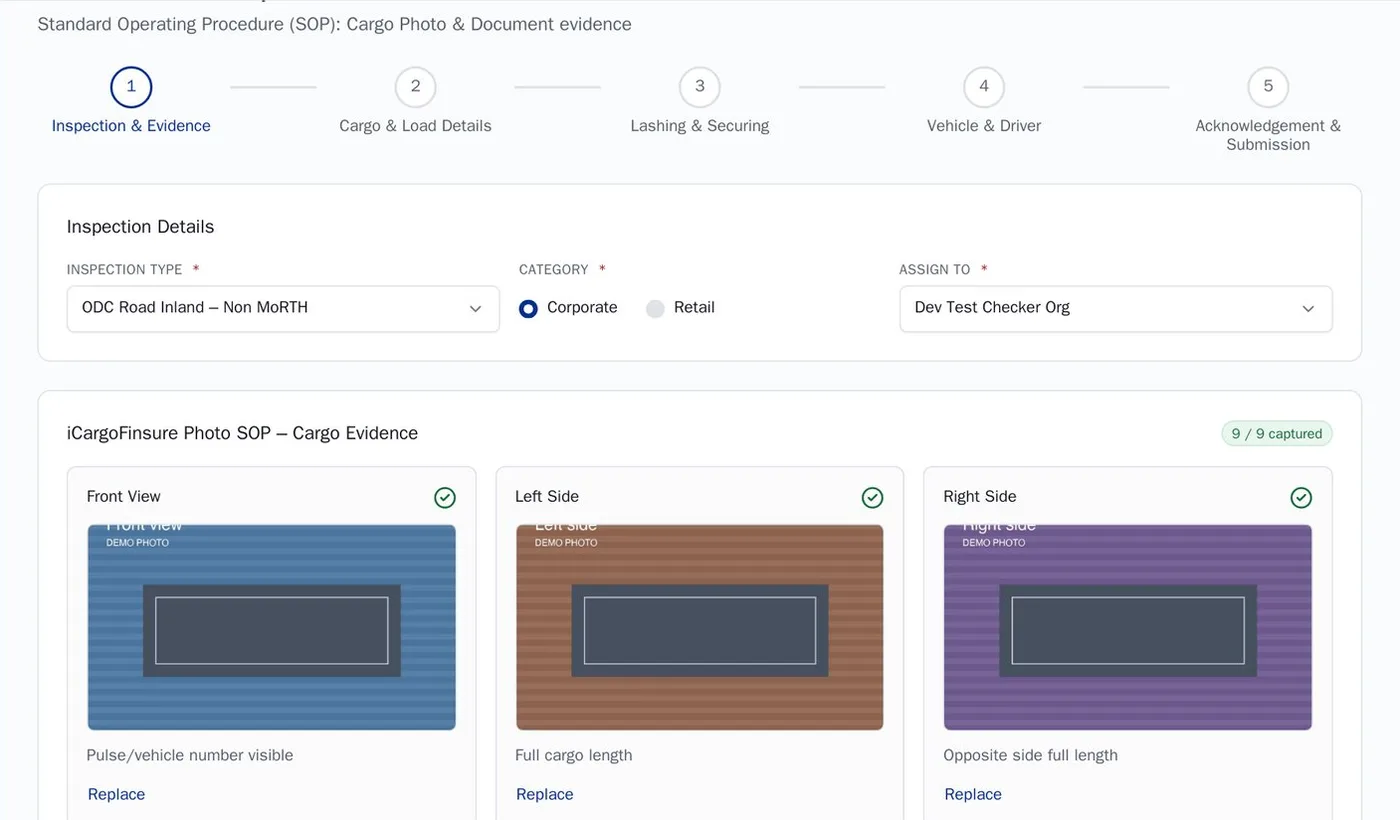
The SOP photo step of the maker's inspection

Why the evidence comes first

  • CauseA photo that is missing, blurred or taken after loading cannot show the cargo as it left.
  • EffectAt claim time nobody can prove condition or securing at dispatch, so the file is argued instead of settled.
  • In the AcademyPack all ten photographs, then see which gaps a checker would reject.
See why, in the Academy
Steps 1 to 5

The maker's inspection

Ten SOP photographs, documents, packages, centre of gravity, dunnage, lashing, vehicle, driver and submission.

Open →
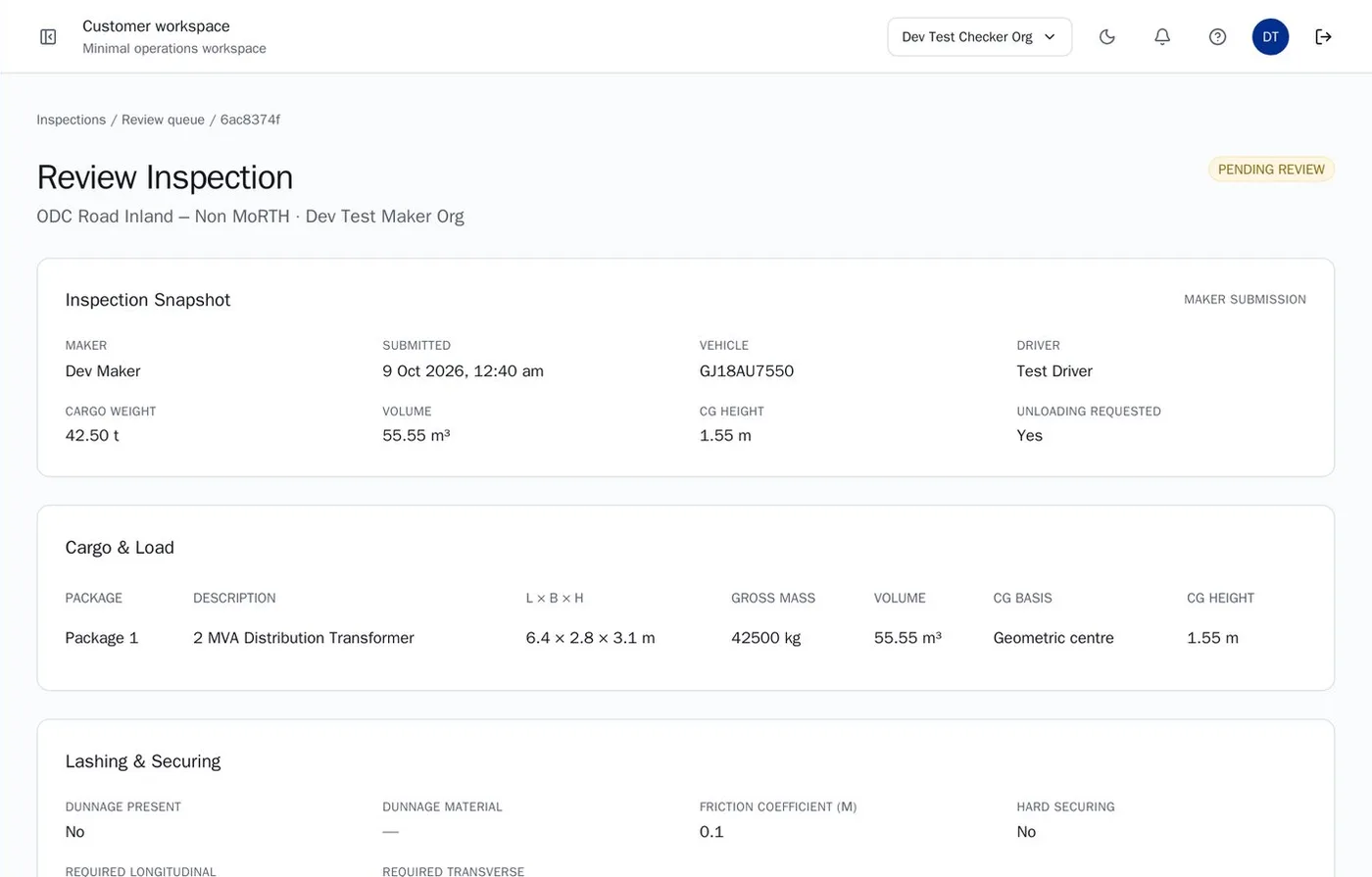
The checker's review screen with the maker's submission

Why a second person signs

  • CauseOne person capturing and approving their own record leaves every slip invisible.
  • EffectA wrong weight or centre of gravity flows straight into the securing check and the report.
  • In the AcademyReview a submission, correct a field with a reason, return it or approve it.
See why, in the Academy
Independent review

The checker's desk

Correct cargo details with a reason, return to the maker, or approve. Audit trail kept.

Open →
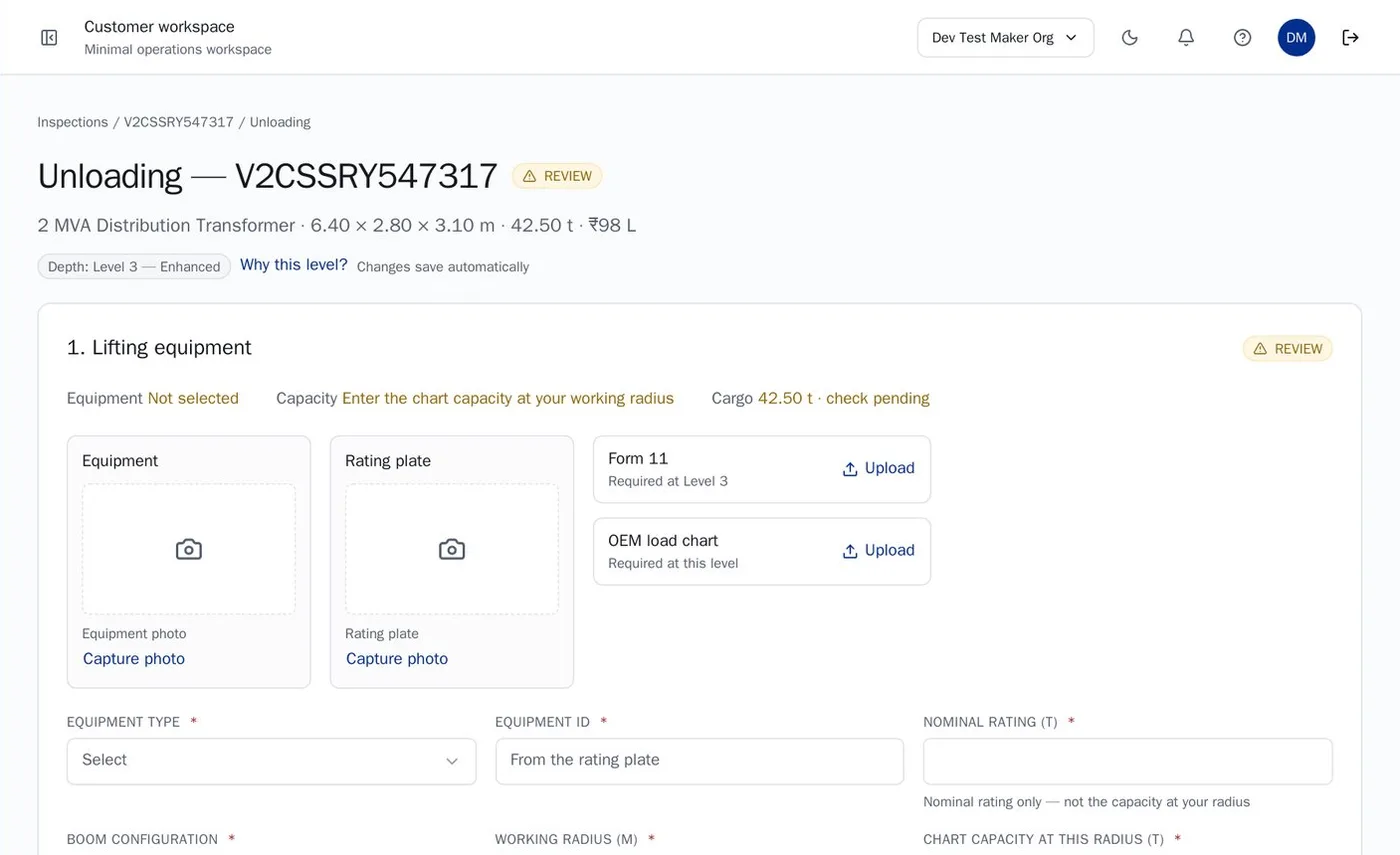
The unloading confirmation screen

Why the last step still matters

  • CauseCrane capacity falls as the working radius grows, so a rating on paper may not hold at the lift.
  • EffectIf rated capacity at the radius is below the load, the right call is HOLD, not lift.
  • In the AcademyCheck the rating against the chart, approve four photos and decide go or hold.
See why, in the Academy
Tail-end

Unloading mission

Equipment rating against chart capacity, rigging checks, four photo approvals, incidents and HOLD.

Open →
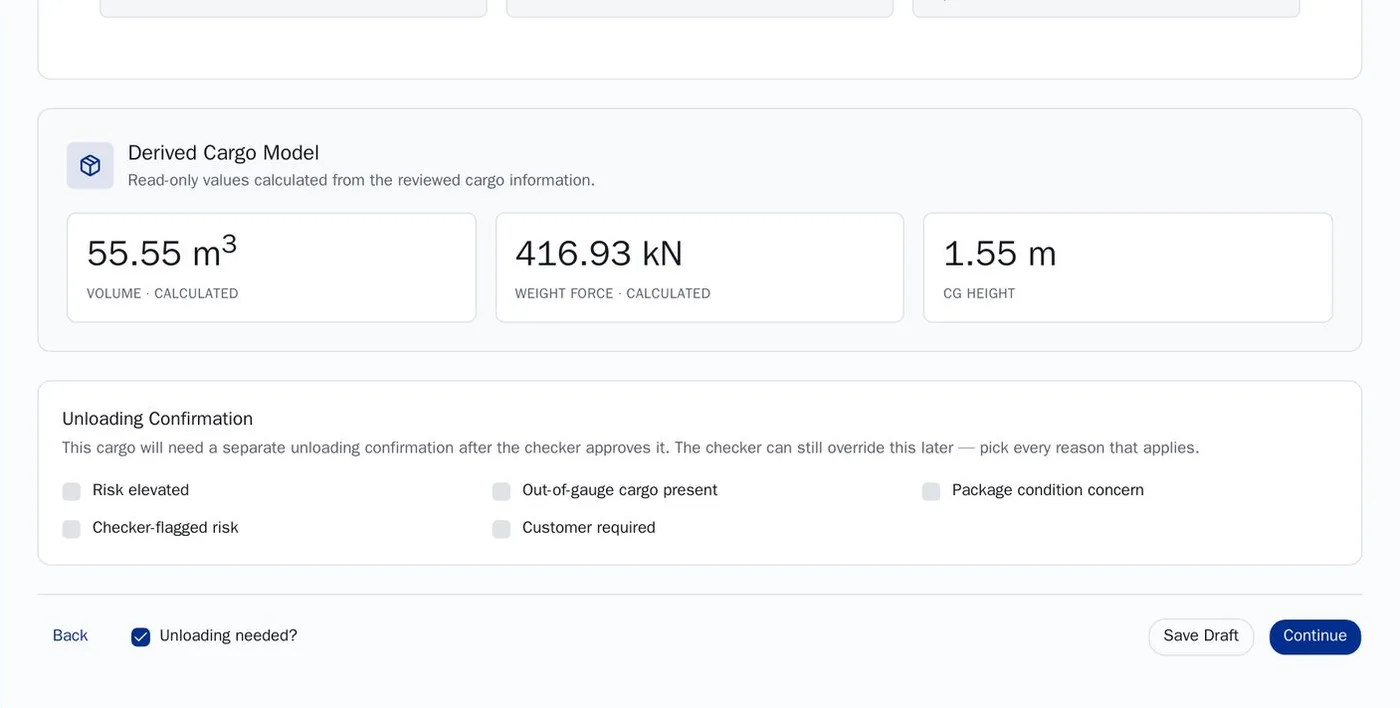
The derived cargo model with weight and centre of gravity

Why the numbers decide the verdict

  • CauseBraking and cornering push cargo with forces of up to 0.8 g forward and 0.5 g sideways.
  • EffectIn the worked example, 68 t needs 1,001 kN of securing capacity. With 1,236 kN available it passes.
  • In the AcademyChange weight, friction and lashings and watch the margin move. Illustrative only.
See why, in the Academy
Engineering desk

Forces laboratory

0.8 g longitudinal, 0.5 g transverse and 0.6 H assumed CG. Illustrative, not a lashing design.

Open →
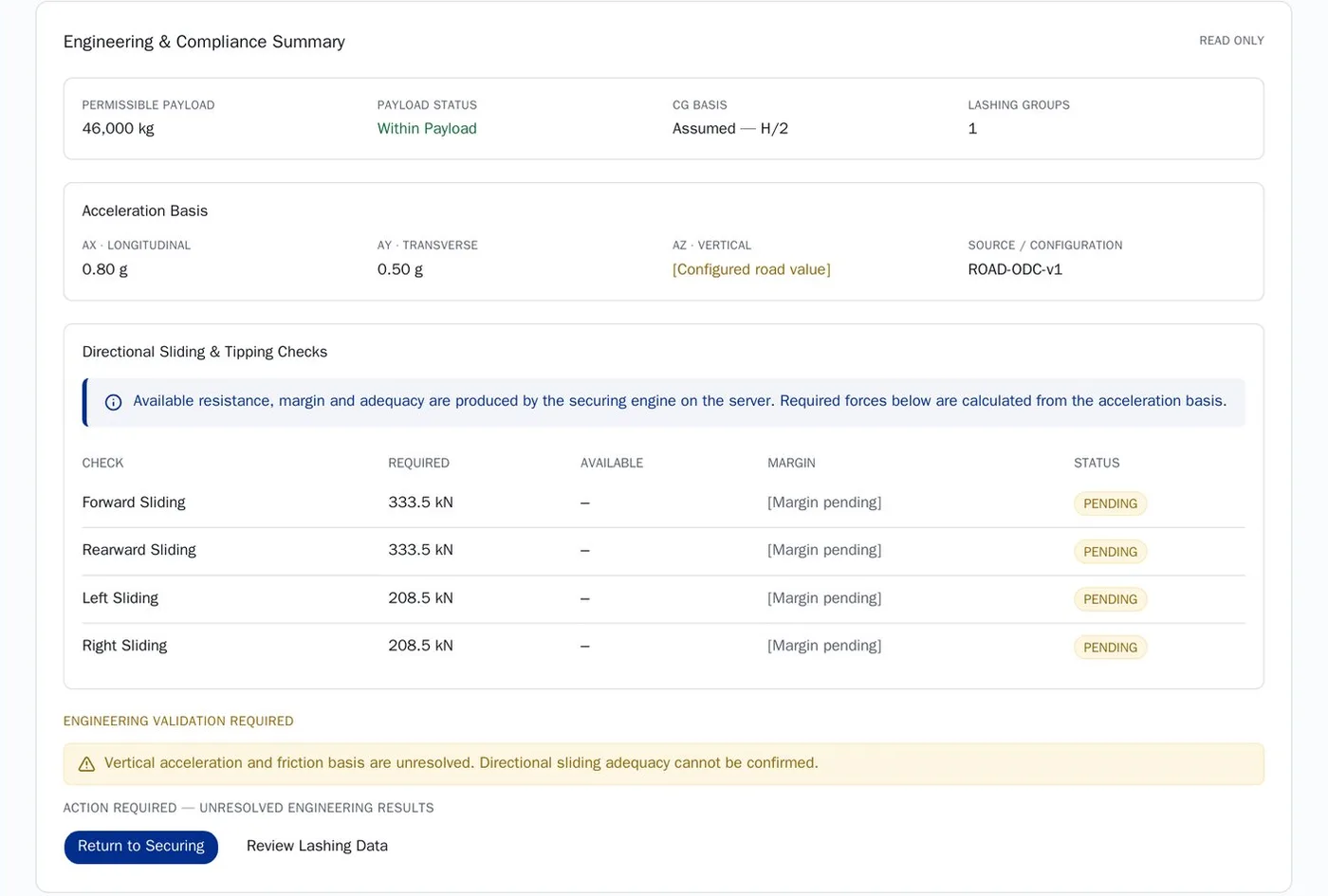
The engineering and compliance summary screen

Why a manual beats memory

  • CauseField decisions are made quickly, away from a desk, with a driver waiting.
  • EffectA searchable manual puts the rule, the table and the screen in one place.
  • In the AcademySearch the 11 chapters and jump to the screen each rule applies to.
See why, in the Academy
Always on hand

Technical field manual

The full client-edition guide, 11 chapters, searchable, with tables and 38 screen placements.

Open →
The maker home dashboard
Real product

Screen atlas and quiz

The real portal screens for paid users, plus ten field decisions to test your judgement.

Open →
Enter the Field Academy

A guided practice environment and technical reference, not a live survey, permit, verified registry response or cargo-securing certification.

Members library

Free checklists, SOPs and reference packs for people about to buy.

Approved contacts get the ODC pre-dispatch checklist, loading and lashing SOPs, survey-report templates and the Field Academy. Ask for access and we will reply with your code.

See what this means for your next heavy move.

Book a live demo

Research

Connect with us in the rabbit hole.

The thinking behind the platform, with the 2025 inspection data behind it: why inland ODC risk hides in the tail, and why an inspection-first record can see it before the loss.

Working paper · December 2025

Re-Engineering Inland Transport Risk: A System-Powered Inspection Stack for Tail-Risk Detection in Indian Over-Dimensional Cargo Movement

Varun Gowariker, Murugan Lakshmanan and Bhavani N.

Claims and loss runs describe risk after the fact. Using anonymised 2025 inspection data, the paper looks at tail delays, concentrated exposure and delay amplification, and finds that risk clusters around combinations of operator behaviour, route constraints and governance gaps rather than shipment volume alone.

Zenodo DOI 10.5281/zenodo.18044161. Opens in a new tab.

364views on SSRN and Zenodo
31downloads
54pages
Explore the research, charts and citations →

1. Where the tail sits

Mean 1.4 days and P90 2 days, yet the slowest inspection ran 11. Orange bars sit beyond P90.

2. How concentrated is exposure?

Carrier concentration is high, and higher by shipments than by money.

3. Frequent is not exposed

Each bubble is a carrier. Two smaller carriers carry the worst tails.

Computed from 242 anonymised 2025 inspections, with identifiers replaced by rank labels. See all seven charts or the full analytics.

The team

The people behind iCargoFinsure.

Portrait of Brijesh Patel, CEO and CMD of iCargoFinsure

Brijesh Patel

CEO / CMD

LinkedIn

Portrait of Varun Gawarikar, CPO and CMO of iCargoFinsure

Varun Gawarikar

CPO / CMO

Embedding Insurance. Integrated Logistics. Angadiya Trust Chains.

LinkedIn

Our community: a LinkedIn group of 37k+ members and a WhatsApp community of 1k+ members. Figures supplied by iCargoFinsure on 18 October 2026, from the group pages.

Portrait of Shubham, Tech Lead at iCargoFinsure

Shubham

Tech Lead

I take systems from idea to production.

Portrait of Neelam Gawande, UI UX Developer at iCargoFinsure

Neelam Gawande

UI UX Developer

Making complex things feel simple.

Portrait of Bhavin Mali, Developer at iCargoFinsure

Bhavin Mali

Developer

From Figma to functional.

FAQ

ODC and OWC questions, answered.

What is ODC cargo in India?

ODC (over-dimensional cargo) is a single indivisible load that, once loaded, exceeds India's standard vehicle dimensions — 2.6 m width, 4.75 m height or 18.75 m length. Transformers, reactors, wind blades, boilers and bridge girders are typical ODC. Movement on National Highways needs prior MoRTH/NHAI permission and state permissions where applicable. See our ODC inspection guide.

What is OWC (over-weight cargo) and how is it different from ODC?

OWC is cargo whose weight pushes the vehicle beyond legal axle or gross limits. ODC is about size, OWC is about weight; heavy project cargo is often both. OWC usually moves on modular hydraulic trailers where MoRTH limits each axle row to 18 t and prescribes HT-1 to HT-13 compositions. Read the OWC guide.

How does iCargoFinsure use AI in an ODC inspection?

Claude-powered extraction reads the invoice, LR, eWay Bill, RC and driving licence (around 80 fields), vision analysis reviews the site photographs, and a rules engine checks dimensions, weight, the eWay Bill ODC flag and lashing capacity. A human maker confirms everything, and a checker approves before an insurer-ready PDF with a QR code is issued.

Does the AI approve the inspection on its own?

No. AI output always lands in the maker's court first, even on a clean parse, and only a checker or admin can approve. The MoRTH dimension and weight softlock is advisory — it flags and explains, and the checker sees the reasons at review.

Can lithium-ion BESS containers be inspected on the platform?

Yes. Containerised battery energy storage moves as UN3536 (lithium batteries installed in cargo transport unit), a Class 9 dangerous good. The workflow captures the DG paperwork, placards, shock/tilt indicators, twist-locks and securing evidence. See the BESS transport guide.

What does an iCargoFinsure inspection report look like?

It is a short PDF: who and what is moving, the vehicle and driver checks, a securing check that sets the force on the cargo against what the lashings hold, ten photographs, and a verdict. Three real reports, with names, tax numbers, vehicles and drivers removed, can be downloaded from the Real reports section of the home page. See the three reports.

How does bidding work?

A bid is your intent to move ODC cargo: one inspection or a repeat programme, over volume, weight and value, in the MoRTH or non-MoRTH category. Send it on the market page and the team responds to your bid. There are no public prices; each bid is answered for its cargo.

Who is ODC OK PLEASE built for?

Corporates and assureds shipping project cargo, independent surveyors, insurers and brokers underwriting transit risk, and transporters/EPC teams who move the load. Everyone works from one evidence chain — cargo, conveyance, driver, route, dunnage, chocking, lashing and unloading.

Is the ODC checker on this page a permit?

No. It is an indicative screen using the same thresholds our rules engine uses. Permits, route surveys and bridge adequacy are decided by MoRTH, NHAI, state PWDs and the route surveyor.


Have a heavy move coming up? Book a live demo.

Book a live demo